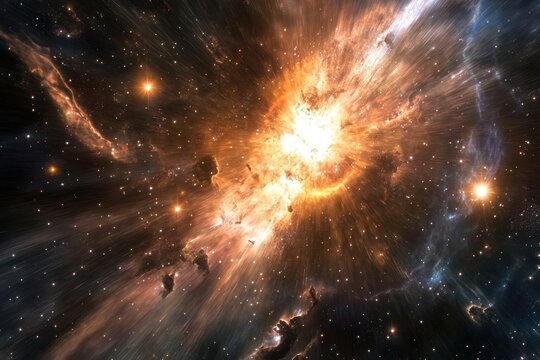
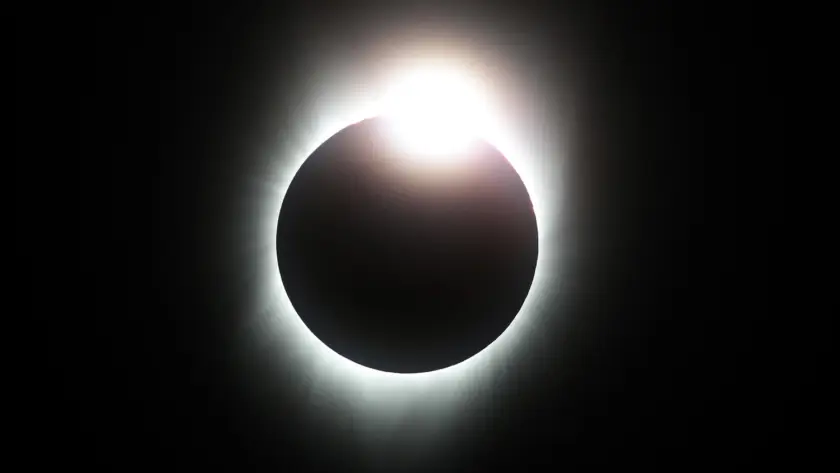
The Large Magellanic Cloud (LMC) is a nearby dwarf galaxy orbiting the Milky Way and is home to several ancient globular clusters. These clusters are tightly bound groups of very old stars, offering valuable clues about galaxy formation and cosmic history.
At RAAVANA, globular clusters in the LMC are studied to understand stellar evolution, gravity,…
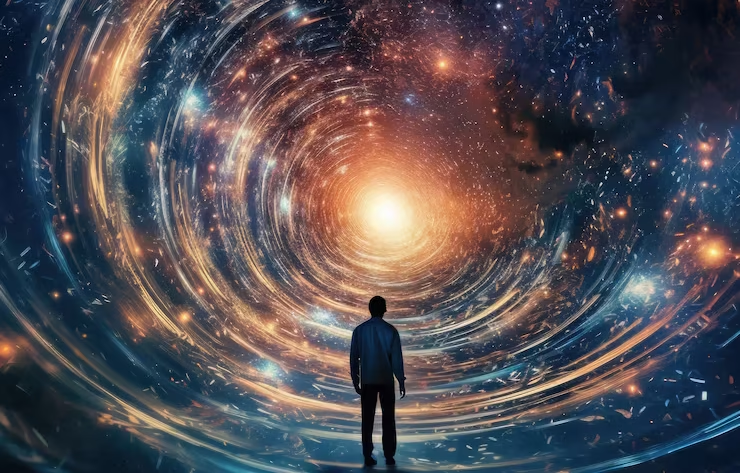
Astronomers have identified a massive stream of stars stretching between galaxies, revealing powerful gravitational interactions on a cosmic scale. These stellar streams are formed when galaxies pass close to each other, pulling stars away through tidal forces.
At RAAVANA, such discoveries are closely studied to understand how galaxies evolve, interact, and reshape the structure of…
The Milky Way is the galaxy that contains our solar system, yet many of its features remain mysterious. Stretching across the night sky as a glowing band of stars, the Milky Way holds billions of stars, planets, gas clouds, and dark matter.
At RAAVANA, studying the Milky Way helps scientists understand galaxy formation, cosmic structure,…
Long before modern telescopes and satellites, ancient scientists carefully observed the sky to understand and predict eclipses. By studying the regular movements of the Sun, Moon, and Earth, early astronomers developed methods to forecast when eclipses would occur.
At RAAVANA, these early techniques are recognized as the foundation of modern astronomical science.
Methods Used…