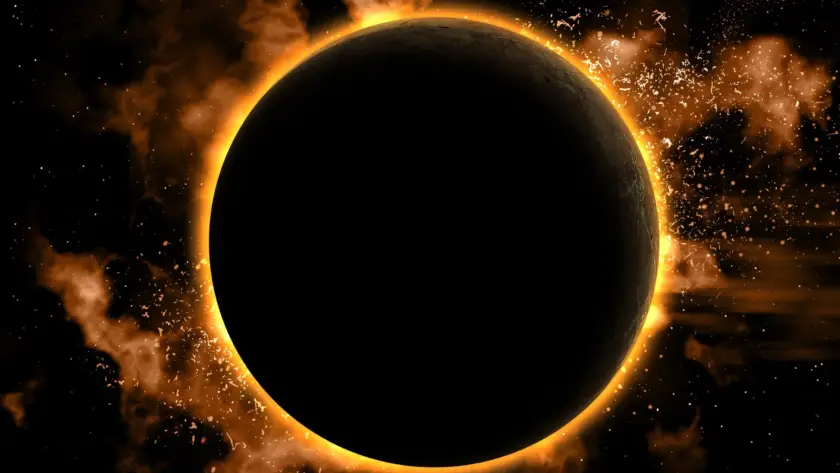
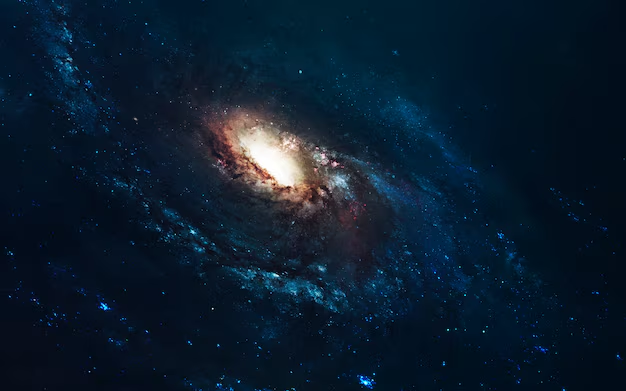
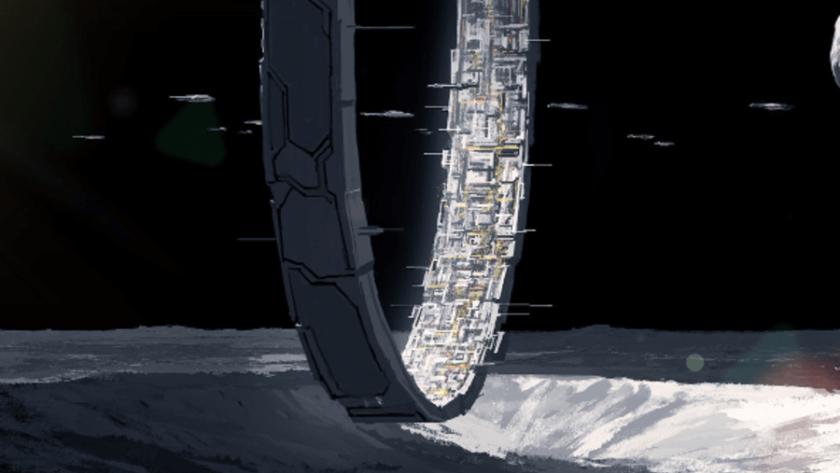
Long before modern telescopes and satellites, ancient scientists carefully observed the sky to understand and predict eclipses. By studying the regular movements of the Sun, Moon, and Earth, early astronomers developed methods to forecast when eclipses would occur.
At RAAVANA, these early techniques are recognized as the foundation of modern astronomical science.
Methods Used…
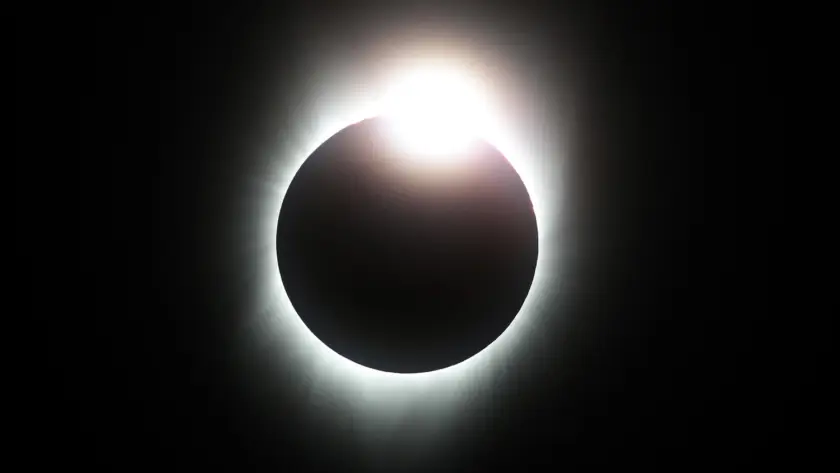
While textbooks explain the basics of our solar system, many of its greatest secrets are still being explored. From hidden oceans beneath icy moons to mysterious planetary atmospheres, the solar system continues to surprise scientists.
At RAAVANA, studying these lesser-known discoveries helps expand knowledge beyond traditional learning and supports advanced space research.
Hidden Mysteries of…
Quantum physics explores the universe at its most fundamental level, revealing how matter, energy, space, and time interact in ways that defy classical intuition. At RAAVANA, understanding quantum phenomena supports advanced space research, satellite technology, and next-generation aerospace systems.
Key Concepts in Quantum Physics Relevant to Space Research
Wave-Particle Duality Particles like electrons and photons…
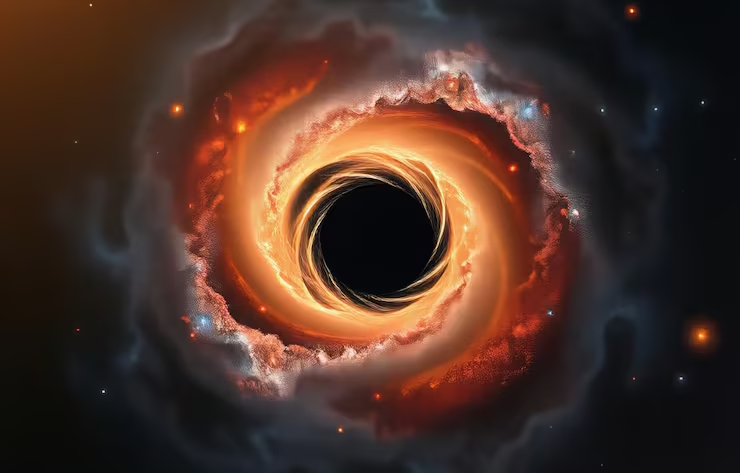
Black holes are regions in space with extremely strong gravity, where matter and light cannot escape. While they are often depicted in science fiction as portals to other worlds, current scientific understanding shows that black holes do not serve as gateways, but studying them reveals extreme physics and the limits of our universe.
At RAAVANA,…
Mars represents the next major frontier in human space exploration. Sending humans to Mars is not just a technological challenge, but a scientific milestone that could redefine humanity’s future beyond Earth.
At RAAVANA, Mars missions are studied as a key step toward deep-space exploration, planetary science, and long-term human presence in space.
Why Mars Is…
The question of whether life exists beyond Earth remains one of the greatest mysteries in science. Astronomers and astrobiologists around the world continue the search for alien life by studying planets, moons, and distant star systems for signs of habitability.
At RAAVANA, the search for extraterrestrial life is viewed as a key scientific pursuit that…
Beyond our atmosphere lies a dynamic environment filled with Near-Earth Objects (NEOs). At RAAVANA, we act as the sentinels of our planet, dedicated to the detection and tracking of comets and asteroids that cross Earth's orbital path. Understanding the composition and trajectory of these celestial bodies is not just a scientific pursuit; it is a…
Every mission into the unknown reaches a defining "moment of truth"—that critical instant where years of engineering, training, and courage are put to the ultimate test. For American space travelers, this moment often occurs during the high-stakes phase of atmospheric re-entry or the final seconds of a lunar touchdown. At RAAVANA, we study these pivotal…
The 21st century has transformed astronomy through advanced telescopes, space missions, and data-driven research. These discoveries have reshaped our understanding of the universe, from distant galaxies to the fundamental nature of space and time.
At RAAVANA, such breakthroughs are closely followed to support Sri Lanka’s growing involvement in space science and research innovation.
Key Astronomical…
Recent multi-source climate datasets, including satellite observations, ground-based measurements, and ocean monitoring systems, have confirmed historic records in global climate indicators. These include sustained increases in global mean surface temperature, ocean heat content, sea surface temperature anomalies, and atmospheric CO₂, CH₄, and N₂O concentrations.
The accumulation of excess heat within the Earth system indicates a…
Astronomy continues to uncover phenomena that extend far beyond current theoretical frameworks and observational capabilities. Despite major advancements in astrophysics, cosmology, and space technology, a significant portion of the universe remains unobserved, unexplained, and poorly understood.
Modern observations indicate that ordinary (baryonic) matter accounts for less than 5% of the universe, while dark matter and…
The discovery of exoplanets—worlds orbiting stars beyond our solar system—is one of the most exciting chapters in modern astronomy. At RAAVANA, we study these distant planets to answer the age-old question: Are we alone? By analyzing the light from distant stars, we can detect the presence of planets and determine if they reside in the…