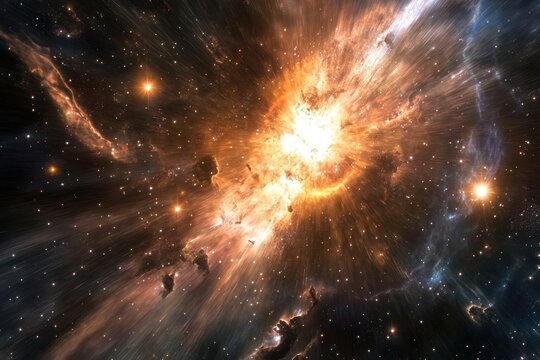
Black holes are regions in space with extremely strong gravity, where matter and light cannot escape. While they are often depicted in science fiction as portals to other worlds, current scientific understanding shows that black holes do not serve as gateways, but studying them reveals extreme physics and the limits of our universe.
At RAAVANA, black holes are explored to understand gravity, spacetime, and high-energy astrophysical phenomena.
What Science Says About Black Holes
- Event Horizon
The boundary beyond which nothing can escape; it does not allow travel to other realms. - Singularity
A point of infinite density at the center, where current physics breaks down. - Spacetime Distortion
Black holes warp space and time, offering insights into general relativity. - Hawking Radiation
Predicted radiation suggests black holes can slowly lose mass over time.
Why They’re Fascinating for Research
Studying black holes helps scientists:
- Test Einstein’s theory of general relativity
- Understand galaxy formation and evolution
- Explore extreme physics conditions
- Improve models for gravitational waves and cosmic phenomena

RAAVANA’s Scientific Perspective
RAAVANA studies black holes through indirect observation, star motion analysis, and high-energy astrophysics. While they are not literal portals, these cosmic objects open doors to unknown scientific knowledge and challenge our understanding of the universe.
Bridging Science Fiction and Reality
Black holes inspire curiosity and imagination, but research transforms these mysteries into measurable science. RAAVANA uses black hole studies to advance Sri Lanka’s role in space research and global astrophysical exploration.